

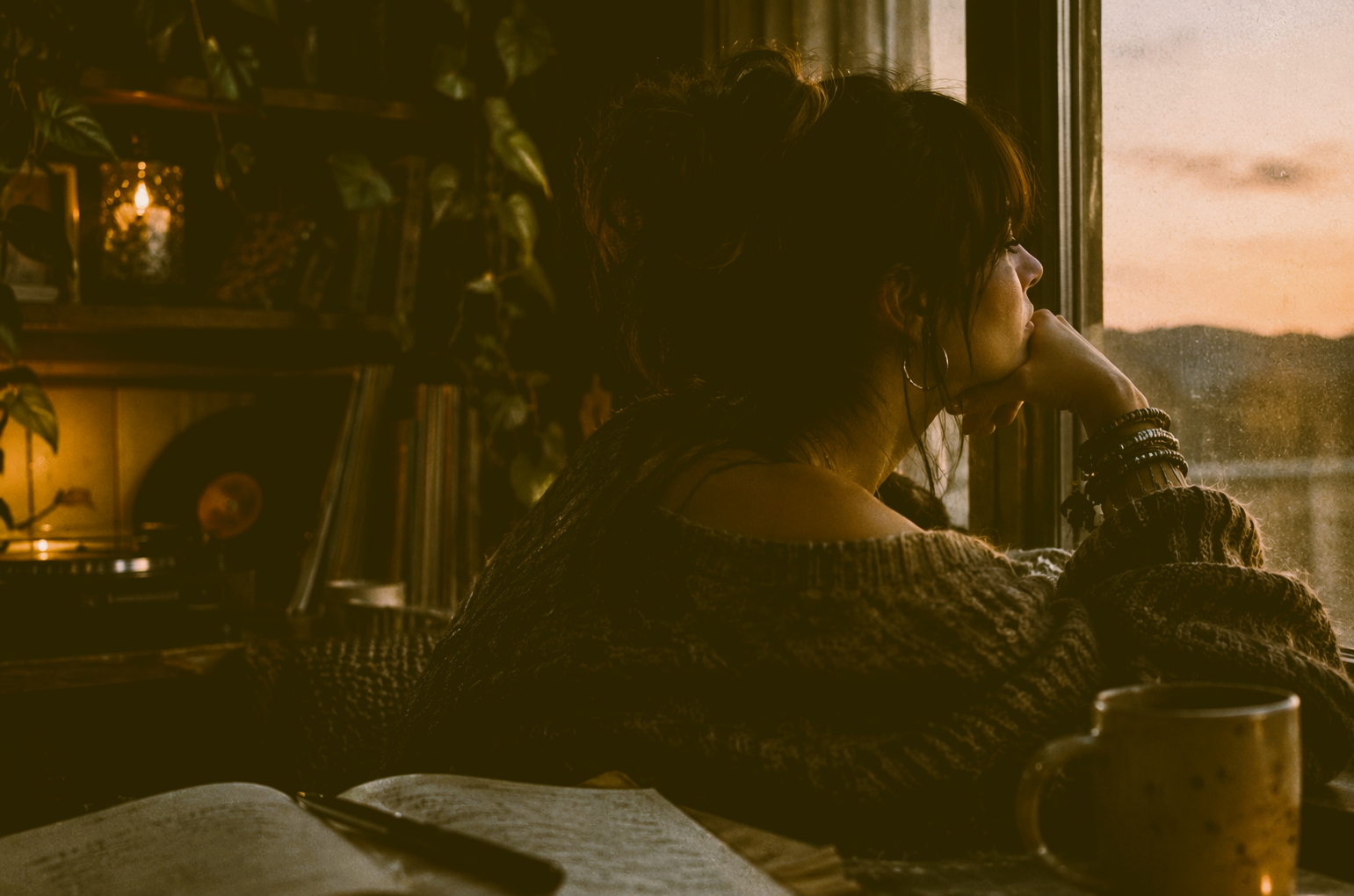
They told me they wished they could spend a day in my mind.
Four days later, I am still trying to understand why it felt like being touched.
There are ordinary ways of being wanted.
To be looked at and found beautiful. To say something clever and watch someone’s mouth surrender to laughter. To be called intelligent, interesting, funny.
Lovely things. But familiar ones.
We understand the currency of them.
Beauty is visible. Wit performs. Intelligence produces evidence.
But the mind –
The mind is private country. No one sees the whole of it. They see what we manage to carry across the border. A sentence. A joke. An opinion. Some strange fact we remembered from something we read six years ago. Fragments declared at customs. The rest remains inside.
And someone told me they wanted in.
Not forever. Just a day.
Long enough, perhaps, to see how one thought becomes another. How I can begin with grandmothers and end up somewhere near the beginning of civilization.
How there has always been someone whose body becomes an archive.
Someone who remembers which child cannot eat what, which story belongs to which ancestor, how the bread is supposed to feel beneath the heel of a hand. Someone who knows this ornament belonged to your mother and that song made your grandfather cry and that when you were three you called strawberries something no one remembers anymore except her.
Anthropologists can give it language.
Matriarch. Kin-keeper. Cultural transmission. Intergenerational knowledge.
But I keep thinking there must have been a grandmother before there was a word for grandmother.
A woman sitting somewhere near a fire who simply remembered.
And because she remembered, everyone else knew who they were.
When she died, someone had to become the remembering.
Maybe this is what we have always done. Passed pieces of ourselves into other people’s keeping and called it culture.
Called it family.
Called it love.
And maybe there is something else I cannot stop wondering now:
Who remembers the woman who remembers everyone?
Who asks what she was thinking while she kept the birthdays and recipes and grudges and stories? Who wonders what she dreamed about? What frightened her? What song she could never hear without becoming seventeen again?
What strange questions kept her awake?
What she noticed when everyone else was busy being remembered?
We are very good at loving people for what they keep for us.
Less practiced, perhaps, at wondering what they keep for themselves.
My mind does this constantly.
Collects. Connects. Keeps.
It refuses to leave anything exactly where it found it.
A grandmother becomes anthropology becomes memory becomes grief becomes the question of who holds a family together when the person who remembered everything is gone.
A movie becomes mythology becomes theology.
I can sit watching an adaptation of The Odyssey, surrounded by the spectacle of an ancient story brought to life, and find myself thinking about something entirely different from what is happening on the screen.
Odysseus leaves Calypso, and I cannot simply watch a man leave an island.
Something in me insists upon seeing absolution.
Temptation relinquished.
A man walking away from one version of himself because faith, whether in a god, a wife, a home, or the possibility that he might still be worthy of any of them, requires him to go.
Later he sits beneath Penelope.
He confesses.
His feet are washed.
And suddenly Homer and scripture are sitting beside each other in my head, separated by centuries and somehow speaking the same language.
Sin. Confession. Water. Return.
I notice when the music disappears.
Perhaps especially when the music disappears.
Silence has always seemed to me like something deliberately placed. An absence can be part of the score.
A missing thing can still have weight.
Maybe I know that because I have spent so much time listening for what isn’t being said.
This is the place they said they wanted to visit.
And I wonder what they imagined they would find.
I wonder if they know it is not particularly orderly here.
There are books left open everywhere. Half-finished questions. Lyrics pinned to memories. Dead women carrying recipes. God hiding in mythology. Anthropology sitting beside cinema.
Beauty beside grief.
Grief beside something funny because apparently even sorrow occasionally needs someone inappropriate to sit beside at dinner.
There are thoughts I have been carrying for years because I have not yet discovered what they belong beside.
There are doors I haven’t opened. Rooms I avoid. Entire wings built from things I loved once.
And somewhere, always, music.
I have spent so much of my life trying to translate this place into something other people can follow.
Trying not to take too long getting to the point. Trying not to explain the connection unless someone asks. Trying to decide which thoughts are worth saying aloud and which should remain inside because the distance between A and B makes perfect sense to me and absolutely no sense once I attempt to draw the map for someone else.
I learned to hand people the conclusion instead of showing them the constellation.
Here.
I connected the stars for you.
You don’t have to watch me do it.
I have mistaken editing myself for making myself easier to know.
And perhaps I have become so practiced at translation that I forgot translation is not the same thing as being understood.
People know the version that crosses the border.
The joke. The answer. The observation. The competence. The remembering.
The finished constellation.
They know what my mind can do for them.
That is not the same as knowing it.
Perhaps that is why their words undid me.
They did not ask me to simplify the map.
They wanted to see it.
There is a peculiar intimacy in that. More intimate, perhaps, than being called beautiful.
Beauty can be admired from a distance. But this was something different.
They weren’t interested in how I appeared to the world. They wanted to know how the world appeared to me.
Through my eyes. Through every book I have swallowed and every song that has left something behind in me. Through the women who taught the women who taught the women who eventually taught me.
Through every story I have loved enough to let alter the furniture.
To know another person’s mind is to know the place they inhabit before they arrange themselves for company.
Before the sentence is polished. Before the joke lands. Before the thought has learned how to explain itself.
To see the raw machinery of wonder. The synapse before the sentence. The spark before it becomes wit.
To know not merely what someone knows, but what they notice.
And maybe that is the most naked thing about us.
Not what we believe. Not what we know. What we notice.
Because attention is involuntary confession.
Show me what your eyes return to and eventually you will show me what you love.
Show me what you cannot stop wondering about and eventually you will show me what you fear.
Show me which silence you noticed. Which grandmother you worried would be forgotten. Which moment in an ancient story looked like absolution to you. Which washing of feet made you think of God. Which absence sounded like music.
And eventually, without meaning to, you will have shown me yourself.
And God. What an intimate thing to want.
I don’t know if they meant it as a compliment.
Maybe it was only an observation made in the middle of a conversation that had wandered, as mine tend to do, several miles from where it began.
But I have carried it for four days like something precious.
Because people have wanted things from me before.
My time. My body. My attention. My competence. My care. My answers. My strength. My remembering.
And there is a particular loneliness in being valued for the things you give so often that no one thinks to ask about the place they come from.
To be useful is not the same thing as being known.
To be needed is not the same thing as being witnessed.
To be loved, even, does not guarantee being understood.
Maybe that is why a single sentence could reach somewhere so many larger declarations have failed to touch.
They did not tell me what my mind could do. They wondered what it was like to live there.
For one impossible little sentence, I was not the keeper. I was not the translator. I was not the person remembering everyone else’s stories.
I was the story someone wanted to read.
The archive someone wanted to open.
The country someone wanted to wander without asking me first to draw them a simpler map.
They told me they wished they could spend a day in my mind.
And perhaps what I heard beneath it was:
I don’t only want what comes out of you.
I am curious about what happens inside you.
Maybe they didn’t mean all of that.
It almost doesn’t matter.
Because for one moment, someone looked toward the invisible country I have spent a lifetime translating for everyone else
and wanted to cross the border.
And I realized
Perhaps being seen is not having someone understand every room inside you.
Perhaps it is simply having someone stand at the door, look at the enormous, strange, crowded place beyond you, and say,
I would like to know this, too.
Leave a Reply