

For the theatre kids, the midnight screenings, and everyone who ever found a little piece of themselves in the wonderfully strange.
When Tim Curry died at the age of 80, I struggled to find the words for what it means to lose someone I never knew, and yet somehow have so many memories with.
I remember the first time Tim Curry came across my screen.
And I know it sounds dramatic to say something like that changed my life. But then again, Tim Curry understood the value of being dramatic.
There are performers you enjoy. There are performers you admire. And then there are the rare ones who somehow become woven into the fabric of your life without ever knowing your name.
Tim Curry was one of those for me.
He was magnanimous. Whimsical. Strange. Brilliant. Completely, unapologetically theatrical.
He could be terrifying one moment and hysterical the next. He could make a villain irresistible, turn a raised eyebrow into an entire performance, and walk into a scene with so much presence that everyone else suddenly seemed to be standing in his spotlight.
And somewhere along the way, he helped teach me to love theatre. Not simply because he performed in it, but because he embodied everything I love about it.
The transformation. The audacity. The permission to become larger than life for a little while. The beautiful ridiculousness of committing completely to the bit. And perhaps most importantly, the understanding that sometimes the people who don’t quite fit anywhere else can find a home beneath the stage lights.
There was something liberating about watching someone so completely committed to being extraordinary. Tim Curry never seemed interested in making a character more palatable by making them smaller. He embraced the peculiarities, the excess, the ridiculousness. He understood that sometimes the very things that make someone strange are the things that make them unforgettable.
Watch Clue and marvel at the controlled chaos of Wadsworth. Watch Legend and remember that somehow the man underneath that extraordinary Darkness makeup still managed to fill every inch of the screen. Watch Annie. Watch Muppet Treasure Island. Watch The Rocky Horror Picture Show.
Listen to his music. Find the performance that made you love Tim Curry. Or discover one for the first time. Because I think that’s how we keep artists.
We pass them along.
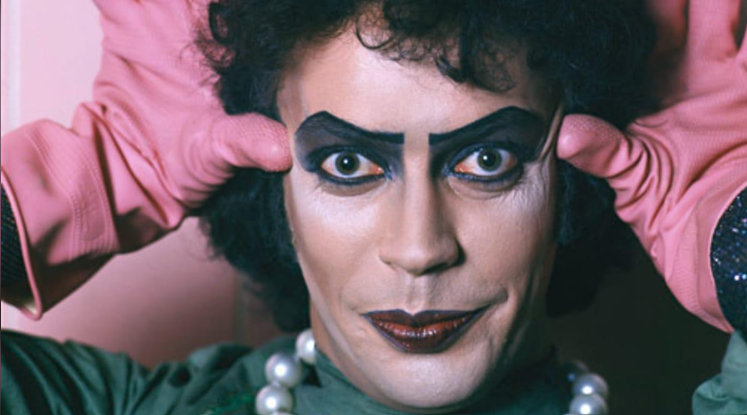
His career began onstage, including the original London production of Hair, before he originated the role that would change everything: Dr. Frank-N-Furter in The Rocky Horror Show.
And when The Rocky Horror Picture Show reached movie screens in 1975, something extraordinary eventually happened.
A movie became a ritual.
For generations, people gathered in dark theaters dressed as characters they loved, shouting lines they’d shouted a hundred times before, singing together, laughing together, and celebrating all the wonderfully strange parts of themselves the outside world sometimes asked them to make smaller.
And standing at the center of that beautiful chaos was Tim Curry.
There’s something almost sacred to me about that.
Because theatre has always been more than entertainment. It’s community. It’s memory. It’s the strange alchemy that happens when performers and audiences agree, for a few hours, to believe in something together.
And sometimes those memories outlive the people we made them with.
I have memories of singing Rocky Horror lines with people who are no longer here. I have memories of introducing Legend to people who had never seen it. I have memories of discovering characters who seemed to give me permission to love all the wonderfully peculiar things about myself.
And now my own children know and love pieces of this strange, magnificent theatrical world that performers like Tim helped build.
That’s the part of losing an artist that can hurt so unexpectedly. Because the grief isn’t always about the person themselves.
Sometimes it’s about the memories that suddenly feel a little further away.
The living rooms.
The movie nights.
The inside jokes.
The songs shouted with friends.
The people who sat beside us.
The younger versions of ourselves who watched something for the first time and had absolutely no idea it would become part of us forever.
We aren’t grieving a stranger as though we knew him.
We’re grieving all the places his art lived in our own lives.
And perhaps that’s why the loss can feel so personal, even when the relationship was never personal in the traditional sense.
An artist doesn’t have to know your name to become part of your story. Sometimes all they have to do is create something that finds you at precisely the right moment.
Something that makes you laugh when you desperately need to.
Something that makes you feel a little less strange.
Something that gives you a language for parts of yourself you haven’t quite learned how to explain.
And years later, you realize that somewhere along the way, their work became part of the way you remember your own life.
Tim Curry never knew me.
But his art found me anyway.
And I’m so grateful that it did.
There is a song in The Rocky Horror Picture Show called I’m Going Home.
Beneath all the spectacle of Rocky Horror, beneath the fishnets and glitter and camp and glorious absurdity, there is this startlingly vulnerable moment.
Frank sings about going home.
And for a character who spends so much of the story being gloriously larger than life, there is something devastating about that sudden smallness.
The longing beneath the spectacle.
The vulnerability beneath the audacity.
The simple, achingly human desire to belong somewhere.
It feels particularly poignant now.
Because for so many people, Rocky Horror became exactly that kind of place.
A home.
Not one made of walls or windows or a familiar address, but of people gathering in the dark and finding one another through something wonderfully strange.
A place where being different wasn’t something to apologize for.
Where the oddballs and outsiders could be magnificent.
Where theatricality wasn’t excess. It was expression.
And Tim Curry stood at the center of it, helping create something that would continue long after the curtain fell.
I think that’s an extraordinary thing to leave behind.
Not simply a collection of performances, however brilliant they were, but a thousand little communities built around them.
Friendships.
Traditions.
Memories.
People finding one another because they loved the same strange, wonderful thing.
So, I hope we keep watching.
Keep singing.
Keep introducing people to the films that made us fall in love with him.
For Frank.
For Wadsworth and Darkness and Rooster and Long John Silver and every wonderfully bizarre character in between.
For the theatre kids.
For the midnight screenings.
For the people we once sang beside who aren’t here to sing with us anymore.
And for every beautifully strange kid who saw Tim Curry command a stage or screen and learned something important:
You don’t have to make yourself smaller to be unforgettable.
If there is one thing I hope we carry forward from artists like him, it’s this:
Love the art loudly.
Show someone the movie.
Play them the song.
Tell them the story.
Pass along the thing that once made your world a little bigger.
Because eventually, the performances end. The curtain falls. The people who made the art are no longer here to make more of it.
But the art remains. And so do the memories we made around it.
Thank you, Tim.
For the laughter.
For the nightmares.
For the music.
For the theatre.
For the whimsy.
For showing generations of us just how magnificent it can be to be a little strange.
And for becoming part of so many memories you never knew you were making.
I hope somewhere, someone is watching Clue for the first time.
I hope a theatre kid is discovering Rocky Horror and realizing there’s a whole world of people who understand them.
I hope someone is playing your music too loudly, laughing at a joke they’ve heard a hundred times, or introducing their children to a character they once loved.
Because that’s how we keep artists. We pass them along.
And somewhere in the passing, a little piece of them stays with us.

Leave a Reply